Why the April 2027 wave matters
The first year had a concession. This one does not.
Sole traders and landlords with qualifying income over £50,000 have had to use Making Tax Digital since April 2026. The next threshold is lower, and the late-update concession does not carry over.
1
Who joins in April 2027
If your qualifying income is over £30,000 for the 2025 to 2026 tax year, you will need to use Making Tax Digital for Income Tax from 6 April 2027. Qualifying income is gross self-employment plus property income, before expenses.
Source: Find out if and when you need to use MTD for Income Tax2
No points in 2026 to 2027
There are no penalty points for missing a quarterly update deadline in the 2026 to 2027 tax year. People in the first wave still had to keep digital records and send updates before they could submit a tax return. Penalties still apply for late tax returns and late payments.
Source: Penalties for MTD for Income Tax; HMRC news, 12 August 20263
Points from 6 April 2027
From 6 April 2027, points-based penalties apply when a quarterly deadline is missed. You get one penalty point for each missed quarterly update (and for a missed tax return deadline). At 4 points, a £200 penalty is charged, then £200 each time you miss another submission deadline.
Source: GOV.UK penalties guidance (updated 30 March 2026); HMRC news, 12 August 2026
You can only get one penalty point per deadline, even if you have more than one business. Points below the 4-point threshold are removed 24 months after the missed deadline. If you reach 4 points, they are not removed automatically: you need a period of compliance, as set out on the penalties page.
For context, HMRC reported that more than 436,000 sole traders and landlords had sent their first quarterly update by 12 August 2026, and over 570,000 had signed up. That was the first wave (qualifying income over £50,000), not this one. Source:
HMRC, 12 August 2026.
What the kit helps you do
A plan for the rules, not a sales pitch
The guide is written in plain English. Each section links to the GOV.UK page it is based on, so you can re-check it.
Work out whether you're in
A step-by-step self-check of qualifying income, using HMRC's approach: gross income, not profit; your share of joint property; what is excluded. It links to HMRC's checker. Only HMRC or a qualified adviser can confirm your position.
Know your dates
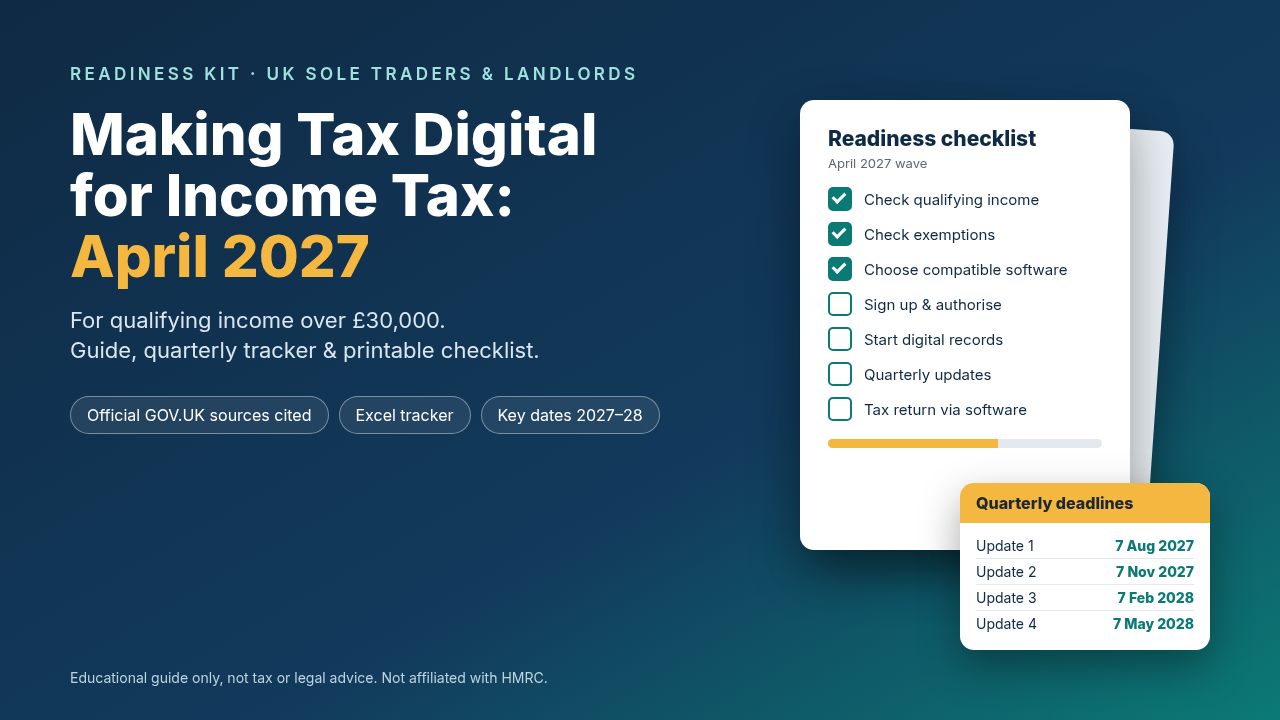
A 2027 to 2028 calendar of the four quarterly deadlines, the two Self Assessment returns you still file, payments on account, and your first MTD tax return on 31 January 2029.
Choose software without a ranking
Neutral criteria taken from HMRC's guidance, plus a link to HMRC's software finder. The guide does not recommend or rank any product. HMRC says it does not recommend any product.
Set up digital records
HMRC's self-employment and property categories, digital links for spreadsheet users, simpler categorisation under £90,000, and how long to keep records.
Landlord specifics
Joint property, one UK property business, per-property records for foreign lets, residential finance costs, and Rent-a-Room relief. All from HMRC guidance.
A quarterly routine, and exemptions
A repeatable checklist so each update is routine. The guide also explains who is automatically exempt, who must apply, what HMRC will not accept, and how to apply by phone or letter.
What's included
Three files. One download.
Delivered as a single ZIP: MTD-2027-Readiness-Kit.zip. Instant download after checkout on Gumroad.
PDF
MTD 2027 Readiness Guide · 17 pages
Self-check flow, qualifying income, the 2027 to 2028 key dates calendar, Self Assessment compared with MTD, the points-based penalty system, neutral software criteria, digital records, landlord notes, the quarterly routine, end-of-year tax return steps, common mistakes, exemptions and how to apply, a glossary, and a full list of official sources.
XLSX
Quarterly tracker · Excel
Transaction sheets for self-employment, UK property and foreign property, with dropdowns matching HMRC's quarterly update categories. A Quarterly Summary with cumulative and quarter-only totals for standard or calendar update periods. Error checks for missing categories, missing dates and out-of-period entries. A Deadlines sheet with status tracking, instructions, and protected formula cells.
This spreadsheet is not HMRC-recognised software and cannot submit to HMRC. Spreadsheet users need compatible bridging software.PDF
Readiness checklist · 2 pages
A printable checklist covering scope, exemptions, software, sign-up, key dates, the quarterly routine and year end.
April 2027 Readiness Kit
£39 one-off
Guide, Excel tracker and checklist in one ZIP.
- 17-page source-referenced guide (PDF)
- Excel quarterly tracker
- 2-page printable checklist
Buy the kit, £39
Digital download. Checkout is handled by Gumroad. Price shown is £39.
Who it's for
Sole traders and landlords near, or over, the line
- UK sole traders and landlords registered for Self Assessment
- Qualifying income (gross self-employment plus property income, before expenses) on the 2025 to 2026 return of more than £30,000
- Also useful if you are near the threshold and want to understand the rules
- Not a service that signs you up, files updates, or submits your return
HMRC says it is your responsibility to check whether you need to use Making Tax Digital, even if you have not received a letter. The kit explains the rules and links to HMRC's checker. It does not tell you that you definitely have to join.
What you will still need
Compatible software is separate
Quarterly updates and the tax return go through HMRC-recognised software. If you keep records in spreadsheets, HMRC says you need compatible bridging software to send updates, and you should confirm with the provider that it can read your spreadsheet.
HMRC software finder
Choose the right software (GOV.UK)
Honest notes
What this kit is, and what it is not
Read this before you buy. We would rather you know the limits than be surprised later.
Not tax or legal advice
This is an educational guide. It does not file, submit or sign up on anyone's behalf. No results or outcomes are guaranteed. If your situation is complex, speak to HMRC or a qualified adviser.
Not HMRC
VerifyReady Guides is an independent publisher. This kit is not affiliated with, or endorsed by, HMRC. Information in the kit was checked against GOV.UK as of 28 September 2026. HMRC updates its guidance often. Every section of the guide links to the official page so you can re-check.
The spreadsheet cannot file
The Excel tracker is not HMRC-recognised software and cannot submit to HMRC. It helps you keep and review records using HMRC's categories. To send quarterly updates and your tax return you need compatible software, or bridging software if you stay in spreadsheets.
FAQ
Questions
Who is this for?
UK sole traders and landlords registered for Self Assessment whose qualifying income (gross self-employment plus property income, before expenses) on their 2025 to 2026 return is more than £30,000. It is also useful if you are near the threshold and want to understand the rules.
Does this tell me whether I definitely have to join?
No. It explains HMRC's rules and links to HMRC's official checker, but only HMRC or a qualified adviser can confirm your position. HMRC says it is your responsibility to check, even if you have not received a letter.
Is the spreadsheet MTD-compliant software?
No. It helps you keep and review records using HMRC's categories. To submit quarterly updates and your tax return, you need HMRC-recognised compatible software. Spreadsheet users need bridging software, and should confirm with the provider that it can read their spreadsheet.
Do you recommend a software provider?
No. The guide gives neutral selection criteria taken from HMRC's guidance and links to HMRC's official finder. HMRC itself says it does not recommend any product.
I'm a landlord with a jointly owned property. Is that covered?
Yes. The guide covers how joint property counts towards qualifying income (your share only), the optional simplified record-keeping for joint lets, and the option to add joint-let expenses after the year ends. All of this comes from HMRC guidance.
What if HMRC changes the rules?
Everything was checked against GOV.UK on 28 September 2026, and every section links to its official source so you can re-check. Always confirm on GOV.UK before acting.
Will you file or sign up for me?
No. This is a self-help educational product. It does not file, submit or sign up on anyone's behalf.
Know the threshold. Know the dates. Be ready for the first update.
17-page guide, Excel tracker and checklist. From £39.